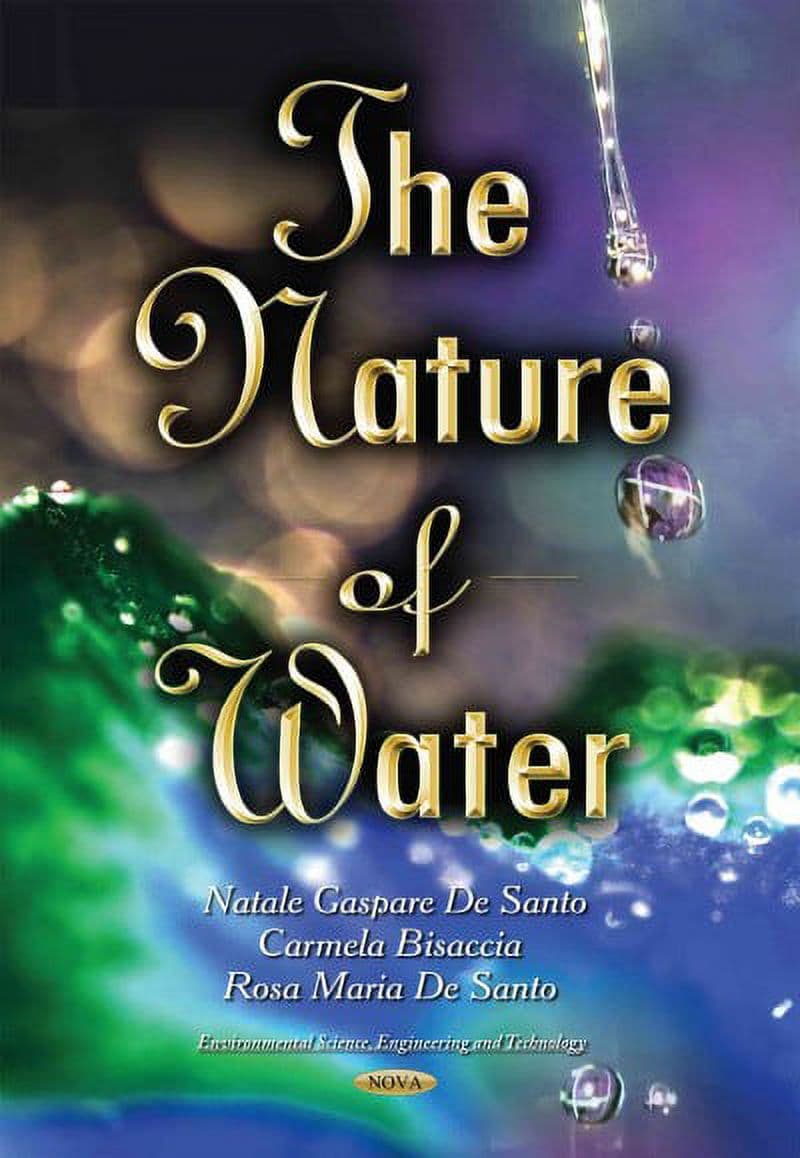
Nature of Water
Water, the most represented substance in the human body, is a trace of the primordial sea where life originated. Its virtues may be represented by the Venus of Botticelli coming out from the sea, as well as by Velasquez's water seller and by Aristophanes' chant of the clouds. Water has been connected with medicine from time immemorial and is a common good. For Sumerians, the physician was the man who new water. Homer's (850-750 BC) mythical tradition made Ocean and Thetys progenitors of all gods and of the world. Hesiod (ca. 700 BC) chanted Poseidon, the sea-lake god, who could cause tempests and seaquakes, generate springs, and also confer the power to walk on water like on earth. For Thales of Miletus (6th-5th centuries BC), water was the basic unique cosmic element (Arkh���������) from which all matter originated. Such theory was echoed by Aristotle (4th Century BC), Cicero and Seneca (1st Century BC) among others. For Hippocrates, moist was a fundamental quality. Galen outlined a therapeutic plan based on preponderance and interaction of four humours (air, earth, fire and water) and four qualities, one being the moisture. Modern science started in Syracuse, where Archimedes discovered the hydrostatic principle. Water has an ambivalent character. It is a curse and a blessing. Floods devastated the earth in the Epic of Gilgamesh, in the Bible, in the Koran and at the end of 2004 during the Tsunami. The kidneys are an efficient water factory. Every minute, 125 ml of fluid are filtered. Everyday, a 70 kg adult man filters 180 litres of fluid, which is reabsorbed at a rate of 99.9%. So the kidneys pass yearly 65,700 litres of fluid and during an average life of 75 years it sums up nearly five million litres. Water is a substance constituted by two atoms of hydrogen bond covalently with one atom of oxygen. The oxygen atom has a greater attraction for electron than the hydrogen atom, the oxygen atom is more negative than hydrogen. Thus the water molecule is in a polarized state, and presents as a tetrahedron with oxygen in the center. Water boils at 100 ���������C and freezes at 0��������� C. The maximum density is achieved at 4 ���������C. Water specific heat is 0.9972. Its viscosity, measured at 25���������C in poise, is 0.008937. Water has the highest specific heat with the exception of liquid ammonia. Heat capacity, which can be calculated as mass times specific heat, is maximal in the nervous system. In humans, water represents 95% of the body weight in the first month of life and nearly 60% in adulthood, being a little more in males, a little less in females and in the obese. In the last century, at the time of the cold war, the information was generated in Moscow about the discovery of polywater, a new form of water, which could be produced in tiny drops in very thin tubes. Astonishingly it boiled at 200 ���������C and had an initial freezing point of around -30 ���������C. Polywater was a case for concern among states because of its potential capability to pollute normal water. Finally it was demonstrated that it was just an artefact due to contamination. Jacques Benveniste, a French immunologist of good reputation came to the conclusion that water saved the memory, being imprinted like a cast. However stringent experiments performed at suggestion of the Editor, showed that water could not act as a template for its molecule
Shipping & Returns
Shipping & Returns